Blog · No spoilers · Leer en español · Ler em português
How to look up a character without getting spoiled (the wiki gives away the ending with a past-tense verb)
Spoilers don't only live in the obvious sentence: they hide in a past-tense verb, in the wiki's status box and in autocomplete. How to search with less risk.

There's a piece of advice every reader has heard at some point, and it sounds like common sense: if you don't want spoilers, don't look things up. It's good advice (like “if you don't want to gain weight, don't eat”), and it has the same problem, which is that it's useless right when you need it. Because we don't look things up out of curiosity. We look them up because we're halfway through a long book, a name has shown up that we can't place, and the alternative is flipping back a hundred and fifty pages to hunt for it with our finger.
The scene repeats so often in forums that it's practically a genre. Someone types a character's name into Google, and before they finish typing, autocomplete suggests the name followed by “death,” or “betrayal,” or “who does she end up with.” They haven't even opened a page. Others do open one, go to the series wiki and read the first line of the profile, which is the most innocent line of all, and there it is: “was captain of the guard until the events of…” That “was” is already a spoiler. We close the tab fast, as if closing it could undo what we read, and go back to the book knowing something we shouldn't.
What I find interesting is that nobody did anything wrong. The wiki isn't acting in bad faith: it's written for people who have finished, which is the right way to write an encyclopedia. Portuguese Wikipedia has a list of the characters in Fourth Wing (in Brazil it's called Quarta Asa) that is an admirable piece of work, and precisely because of that it tells you everything, with each character's status, their relationships and their fate. Even Stephen King's official site has character profiles for The Dark Tower that reveal events from later books. Nobody is hiding the ending behind a warning, because to an encyclopedia the ending is a fact like any other.
So the problem isn't the people who give away endings, it's that almost everything there is to look up is written from the ending. The spoiler doesn't only live in the obvious sentence (“X dies in book three”). It lives in the grammar, in the past-tense verb and the “would go on to become”; it lives in the structure, in the profile's “status” box, in the family tree that shows who marries whom, in the “related characters” list that includes someone who hasn't appeared yet. And it lives in the search engine, which suggests what people search for most, and what people search for most about a character is almost always what happens to them at the end.
I'll grant that some readers don't care about any of this (I know people who read the last page first and live in peace). But forums are full of the opposite: people who dropped a series halfway because someone ruined it for them, and a question that keeps coming back in many forms: is there any way to look up a character without finding out what's coming?
The honest answer is that there almost isn't, but there are ways to limit the damage, and I'll share them in case they help. The first is to search with the book number and the words “no spoilers” in the query, not just the name, because that gives autocomplete less to pull from (it isn't foolproof, but it changes quite a bit of what shows up). The second is to never read the sidebar of a wiki, the box with the picture, which is where the “status” and the “family” live, and to read only the section for the book you're on, if the wiki splits it by book (some fan wikis do, and they tell you at the top which books they cover). The third, the oldest, is to ask someone who's already read it... as long as you tell them exactly where you are, although in my experience that someone always smiles in a way that's already a spoiler.
None of the three fixes the underlying problem, which is that we need a source written from our page and not from the last one. That's harder than it sounds, even for an AI, because it isn't enough to not say the ending: you have to not hint at it, not use the verb tense that gives it away, and know when to stay quiet when someone asks something they shouldn't know yet. An answer like “I can't tell you about that yet” also tells the reader there's something there, and even that has to be handled with care.
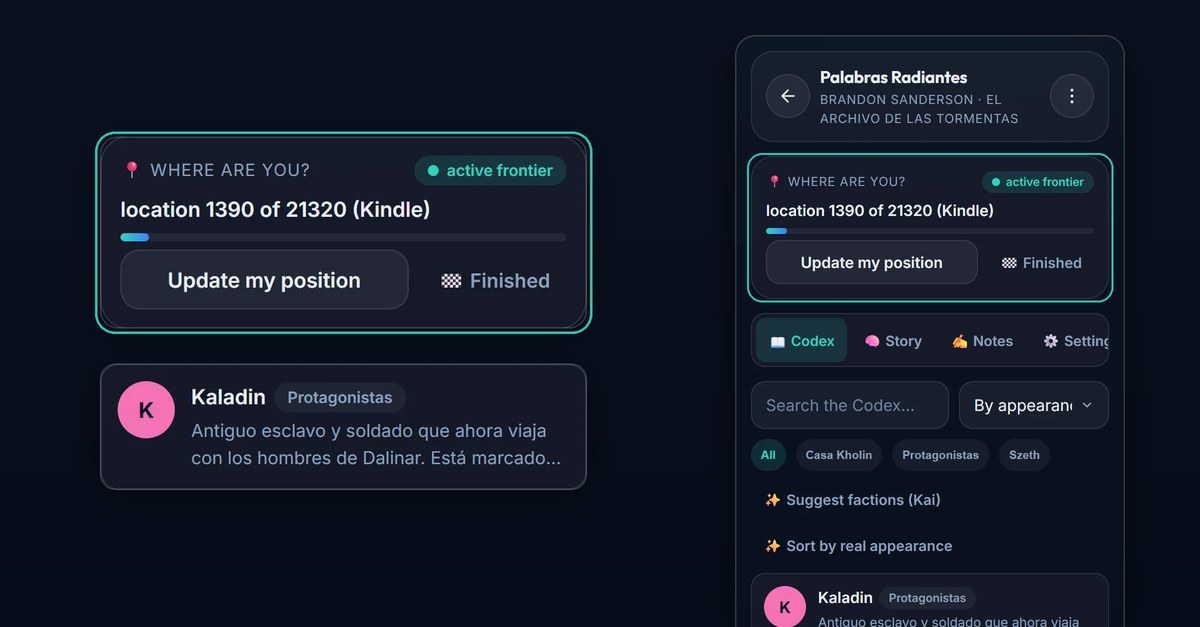
Kai LoreSafe, the tool I built, is designed around that frontier, so read this with the bias of the person who made it. We tell it where we are, and everything it answers (a character's profile, the “where was I?” when we come back to the book, a one-off question) stays limited to that position, with no verbs that give away what's coming and with the rule that, when in doubt, it stays quiet. It isn't perfect, and I'd rather say so myself before you find out: if it doesn't know the book well, it tells you instead of making things up.
I'm left with a question I can't answer: I don't know whether a spoiler really ruins a book or only ruins the surprise and leaves the rest intact. Some people say a good story can survive being told its ending, and I'm not sure they're wrong. What's the spoiler that hurt you the most, and did you find it while looking for help, or did someone tell you without being asked?
See you next time. Mauro Z.