Blog · Series · Leer en español · Ler em português
The Buendía family tree that doesn't give away the ending (or how to read One Hundred Years of Solitude without getting lost among all those Aurelianos)
The Buendía family tree floor by floor, up to where you are and no further, plus the clue the book leaves to tell the Aurelianos from the José Arcadios.
If you've ever searched for “Buendía family tree” halfway through the book, you know what happens. You only wanted to find out whose son the young man who just showed up was, and the tree, being generous, also tells you who dies, who ends up with whom and how the family comes to an end (which is, quite literally, the end of the book). In reader forums the scene comes up so often that it already feels like part of reading García Márquez: someone opens a family tree to settle one doubt and closes it knowing things the novel was going to tell them two hundred pages later.
And lately a lot of people are searching for that tree. The series wrapped up in August, plenty of people picked up the book after watching it (or put it down halfway to watch it), and the trees you find online, most of them made to go along with the series, are drawn from the last page. It isn't bad faith. A family tree is made that way, complete, with every arrow, and for someone who has finished it's exactly what they need. So what are you supposed to do on page one hundred and fifty, with a José Arcadio you can't place?
I'll grant that the tree is useful. I told you a few days ago that I read One Hundred Years of Solitude at university, for pleasure, and that even so I never figured out which Aureliano was which; a family tree would have helped me a lot. The problem isn't the tree, it's where it's drawn from. So I'm proposing two things you can actually use halfway through the book: a clue García Márquez himself leaves in writing, and a family tree built floor by floor, up to where you are and not one branch further.
The clue is in chapter ten, and it's one of the most useful things anyone has ever told me about this novel (although the one who told me was the narrator, and late). Names in that family don't repeat at random. According to the book itself, the Aurelianos tend to be withdrawn, with lucid minds, while the José Arcadios are impulsive and enterprising, and on top of that marked by a tragic fate. So when a repeated name shows up, before you reach for the family tree, ask yourself how quiet or how headstrong the one in front of you is. It doesn't solve everything, but it sorts out a lot.
And now the tree, floor by floor. The first floor belongs to the founders: José Arcadio Buendía and Úrsula Iguarán, who are cousins, and that kinship is no small detail (the book explains from its first pages why it frightens the family). Their children are José Arcadio, the eldest; Aureliano, the one the novel's very first sentence already introduces as a colonel; and Amaranta. And there's Rebeca, who arrives from outside at eleven years old, carrying her parents' bones in a canvas sack, and whom the family raises as its own.
The second floor gets tangled because of Pilar Ternera, who has a son by each of the two brothers: Arcadio, José Arcadio's son, and Aureliano José, the colonel's son. Then come the seventeen Aurelianos, the sons the colonel has during the wars with seventeen different women, all with the same first name and the mother's surname after it (Aureliano Triste, Aureliano Centeno, Aureliano Serrador, and so on). Luckily, you don't have to learn those one by one. Knowing that they exist and that they're half-brothers is enough.
The third floor belongs to Arcadio's children with Santa Sofía de la Piedad: Remedios, whom the whole town ends up calling Remedios the Beauty, and the twins José Arcadio Segundo and Aureliano Segundo. This is where the chapter ten clue is put to the test, and I'm not going to tell you how it turns out (but it's worth having it handy when you get there).
That's as far as this tree goes, and it's on purpose. From the next floor up, every new name comes with a piece of the plot attached (who arrives from where, who falls in love with whom), and the top floor is, without exaggeration, the ending of the novel. If you're further along and need to place someone from higher up, my advice is the usual: put the chapter in your search, and never open a complete family tree hoping to look at just one branch. Your eyes go to the last one on their own.
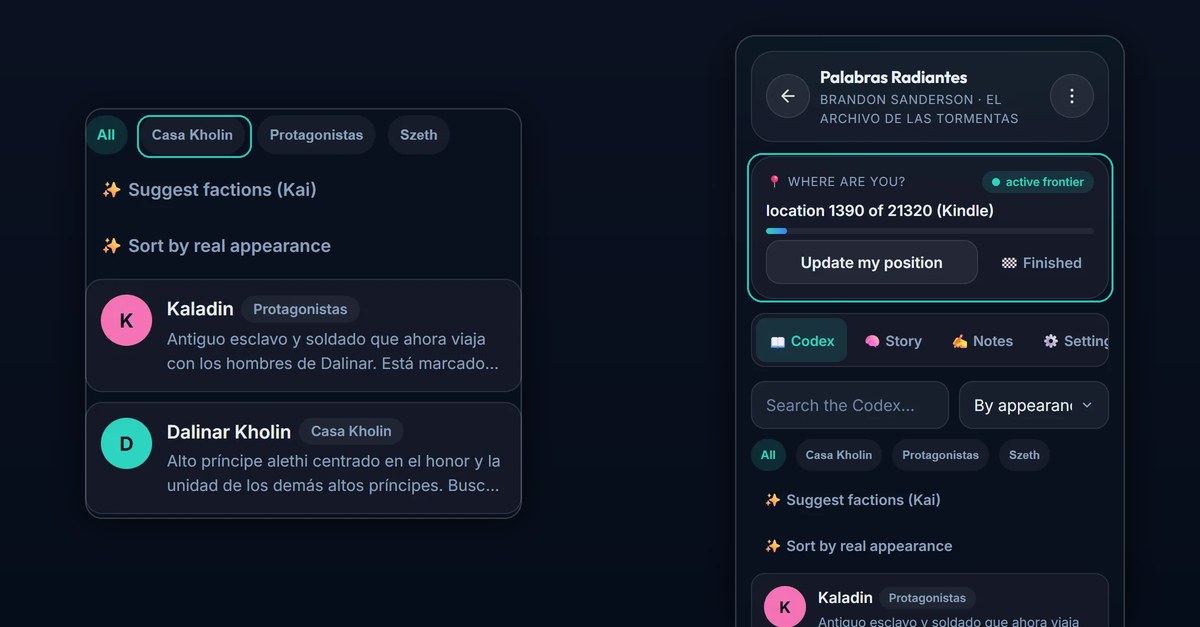
For anyone who'd rather not depend on a family tree drawn by someone else, Kai LoreSafe, the tool I built, does this same thing with whatever book you're reading, so read this with the bias of the person who made it. You tell it where you are and it puts together the who's who up to that page, without the branches you're not meant to see yet. And with One Hundred Years of Solitude, where one name can be four different people, that's where it makes the most sense.
There's one question I can't settle. Maybe getting lost among the Aurelianos is part of what García Márquez wanted us to feel, that sense of the family's story circling back on itself, and a family tree that's too tidy takes it away from us. Maybe. But I think getting a little confused is one thing, and giving up on the book at page two hundred because we no longer know who's who is quite another.
Which Aureliano did you get lost in, or which José Arcadio? And for those who read it twice: did you understand it better the second time, or enjoy it less?
See you next time. Mauro Z.