Blog · Remembering · Leer en español · Ler em português
How to remember what you read without rereading the whole book (and why a summary is exactly what you don't need)
Almost nobody forgets what a book was about. What slips away is the index: who's who. Why a summary won't help you remember it, and what actually does.
Reader forums have an explanation that shows up every time someone admits they've forgotten a book: you read too fast, or too tired, or with your phone next to you. It may be true (I wouldn't bet much on my own focus after ten at night), but when you look closely at what exactly gets forgotten, the explanation falls short. Hardly anyone forgets what the book was about or how it felt to read it. What slips away is something else: the index.
Let me explain with the scene that comes up most in those threads. A reader is on page three hundred of a fantasy series when a name appears that she recognizes (she knows she's read it, she's sure of it) and she has no idea who it is. Is it the king's cousin, or the captain who switched sides in chapter nine? What she does, she says, is what thousands of others do: put a sticky note on each character's first appearance so she can go back to it when the name returns. It works. It also turns the book into a filing cabinet.
That, I think, is what we really forget. A long book asks us to remember in an order we didn't choose: the names almost all arrive at the start, when we don't care about them yet, and come back two hundred pages later, when they matter a lot. We carry the feeling of the story just fine; what we don't carry is the who's-who table, and that's exactly the table the author assumes we have.
To get a sense of how big the problem is, think of One Hundred Years of Solitude, the book almost every Colombian reads in school (I actually read it at university, and for pleasure, not as homework; maybe that's why I enjoyed it more, but it didn't help me remember which Aureliano was which). In the novel, Colonel Aureliano Buendía has seventeen sons, and all seventeen are named Aureliano. García Márquez didn't do it out of cruelty (or maybe a little), but anyone who has made it halfway through the book knows that the question “which Aureliano is this?” is part of the experience. And that's a novel of about four hundred pages, while some of the series BookTok recommends today run past a thousand pages per volume, with maps, noble houses and magic systems.
The fixes we use are reasonable, and I mean that. Notes help: some readers write down name, role and relationship to the protagonist, and others retell the story out loud to someone to make it stick, which is an old and good study technique. Rereading helps too, if you have the time (and if the series doesn't have four thousand-page volumes). The problem is that they all send the bill to the same place, which is the pace of your reading: every sticky note is a pause, and every reread is a new book you're not reading.
And then comes the obvious temptation, which is to look up a summary. I have an old fight here: a summary as a substitute for reading strikes me as a bad idea (if the summary is what you want, you don't need the book), but as a memory aid it doesn't work either, and for a more concrete reason. The problem isn't that a summary is short, it's that it tells you everything. A summary is written by someone who has already finished the book, and what comes later seeps into every sentence: the character “who would later betray his brother,” the alliance “that would end badly.” To remember who someone was on page three hundred, a profile written from page one thousand is the worst thing that can happen to us.
What we really need is smaller and rarer: what we already knew, up to where we are, and nothing more. Who this name is according to what I've read, not according to what happens in book four. It's a simple question and almost nobody answers it, because wikis, summaries and even AI answers are written from the ending. If a rule of thumb helps, here's mine: a memory aid is good if it could have been written by someone who is on exactly your page.
In the meantime, some things work without any tool. Write down only the name and one line the first time someone appears (not their story, one line: “the cousin who inherited the port”), because what you'll look for later is that line, not a paragraph. Keep what you know apart from what you suspect, because mixing notes and theories is how you end up convinced of something the book never said. And when you come back to a book after weeks away, reread the last chapter you read, not the first, because I think memory hooks back in better through the end than through the beginning... although that's more hunch than science.
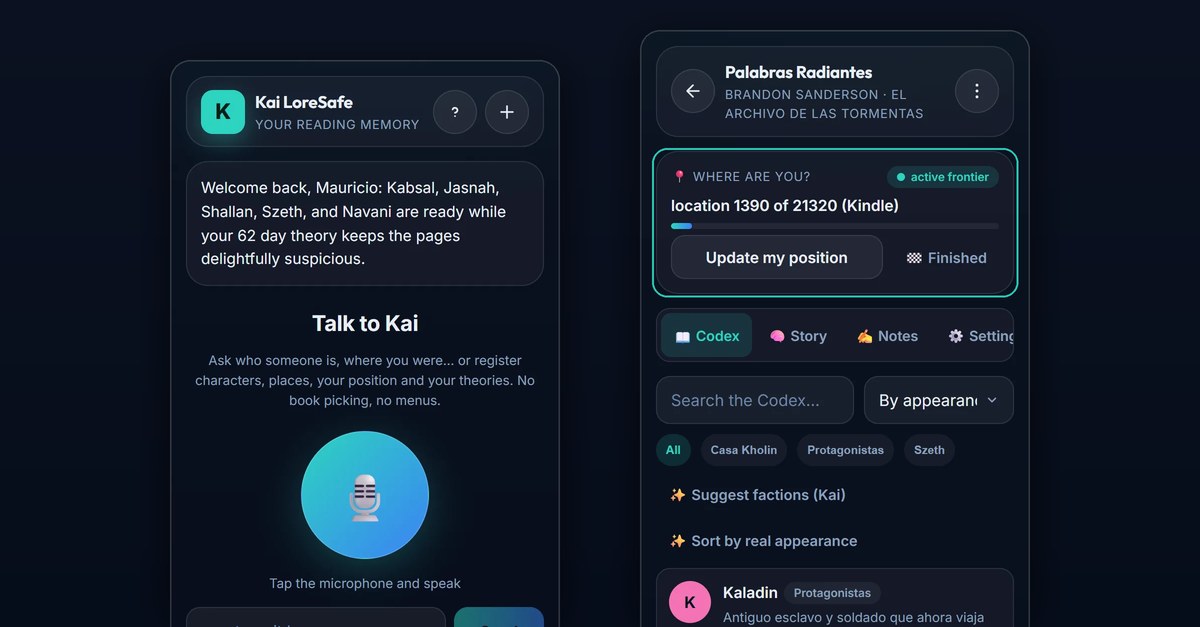
Kai LoreSafe, the tool I built, works on that rule, so read this with the bias of the person who made it. You tell it where you are (the page, the percentage, the minute of the audiobook, or simply “I'm at the part where they crowned the sister”) and it gives you back each character's profile as it stands up to that point, with what you yourself wrote down and not a word of what's coming. And when it doesn't know the book well, it says so, which strikes me as the least you can ask of something that promises not to ruin the story for you.
There's one question I haven't settled. Is remembering who's who part of the pleasure of reading, like putting a puzzle together, or is it pure noise the book charges us for? I lean toward the second for long series and toward the first for short novels, but I'm not sure. What do you do when a name shows up that you can't place: keep going, flip back, or risk looking it up on Google?
See you next time. Mauro Z.
P.S. The question of which Aureliano is which does have an answer, and we're going to answer it, family tree and all, but without telling you the ending. It's coming in a few days.