Blog · Remembering · Leer en español · Ler em português
How to get back into a book you put down months ago without starting over (what you forgot isn't the story, it's where you were)
What you lose in a long pause isn't the story: it's the exact spot where you were standing. Four steps to pick a book back up without rereading three hundred pages.
In reader forums there's a rule that comes up so often it already sounds like law: if you put a book down for a couple of weeks, just look over the last chapter, and if it was months, you start again. It's a reasonable rule (and it has the advantage of not requiring much thought), but when you do the math you see how expensive it is. Someone who stopped on page three hundred of a five-hundred-page book, if they start from scratch, rereads three hundred pages to reach two hundred new ones. They pay more than what's left.
The scene that comes up most often is almost a confession. Someone put a long novel down at forty percent three or four years ago, and every time they think about going back they reach the same conclusion: “I'd have to start over.” Others describe it as a dilemma with no good way out. Rereading from the beginning bores them, because they remember almost everything they've already read, and carrying on from where they stopped frustrates them, because they don't remember the plot. It happens to a lot of people. And often the book goes back on the shelf, now with a bookmark nobody looks at anymore.
That dilemma, I think, is the clue. If rereading is boring because you remember, and carrying on is frustrating because you don't, then what you forgot can't be the same thing in both cases. What goes away in a long pause isn't the story (what it was about, who the main character was, how it felt to read it), it's the exact spot where you were standing: who knew what, which question the book had just opened, who had been left in danger two chapters back. It's like turning on the television at the seventieth minute of a match. You know who's playing, but you don't know who's winning or why there's one player fewer on the pitch.
I'll grant that sometimes starting over is the right call, and I mean it. If the book stalled in the first fifty pages, rereading costs little and almost nothing you read is worth saving. If the pause happened because you weren't enjoying the book (that happens too, and there's nothing wrong with it), going back to the beginning is giving it a real second chance. And some people reread for pleasure, and I'm not going to argue with them about anything. The problem is the rule applied to everything, the one that turns every mid-book pause into a three-hundred-page debt.
What does help, when the pause fell in the middle, looks more like recovering a state than reviewing a plot. The first thing is not to open the book yet. Before that, write down on a sheet of paper (or on your phone, nobody is grading you) what you remember in three minutes, without looking anything up: whatever names come to you, where the characters were, what was about to happen. The list comes out short. It's uncomfortable, but that discomfort is part of the method, because it's the same thing that's recommended for studying (quiz yourself before you reread), although I don't know whether it works as well with a novel.
The second is to go back from the bookmark, a chapter or two, and not from the first page. Some readers go back one chapter in The Brothers Karamazov and that's enough for them, and others just keep going until the thread comes back on its own, which is also a way of trusting the book. What you almost never need is the beginning, because the beginning is exactly what we remember best (we said so a few days ago, when we talked about how to remember what you read without rereading the whole book).
The third is to skim with a question in mind. Not “what happened?”, which is too big, but “what was I waiting for when I put it down?”. I suspect almost every book abandoned halfway is abandoned in the middle of a wait (a letter that hasn't arrived, a journey that hasn't ended, something someone still hasn't dared to tell), and finding that wait is finding the urge to keep going again. Often that's all it takes.
And the fourth is more of a warning: beware of the summary from the internet. It was written by someone who has already finished the book, and the promise to read it “only up to where I was” lasts exactly until the sentence that tells what came next. We've talked about that already, apropos of the wikis that give away the ending with a past-tense verb, and in a long pause the temptation is greater, because you feel entitled to catch up fast.
With a series it's the same, but on another scale. There the pause isn't months but years (between two books in a series that's still being written, five can go by, as happened to those who waited for the sixth ACOTAR book), and what you have to recover isn't a page but a whole book. The logic doesn't change. What you need is what you already knew when you closed the last book, and nothing from the next one, which is what we tried to do with the guide to A Court of Splintered Harmony.
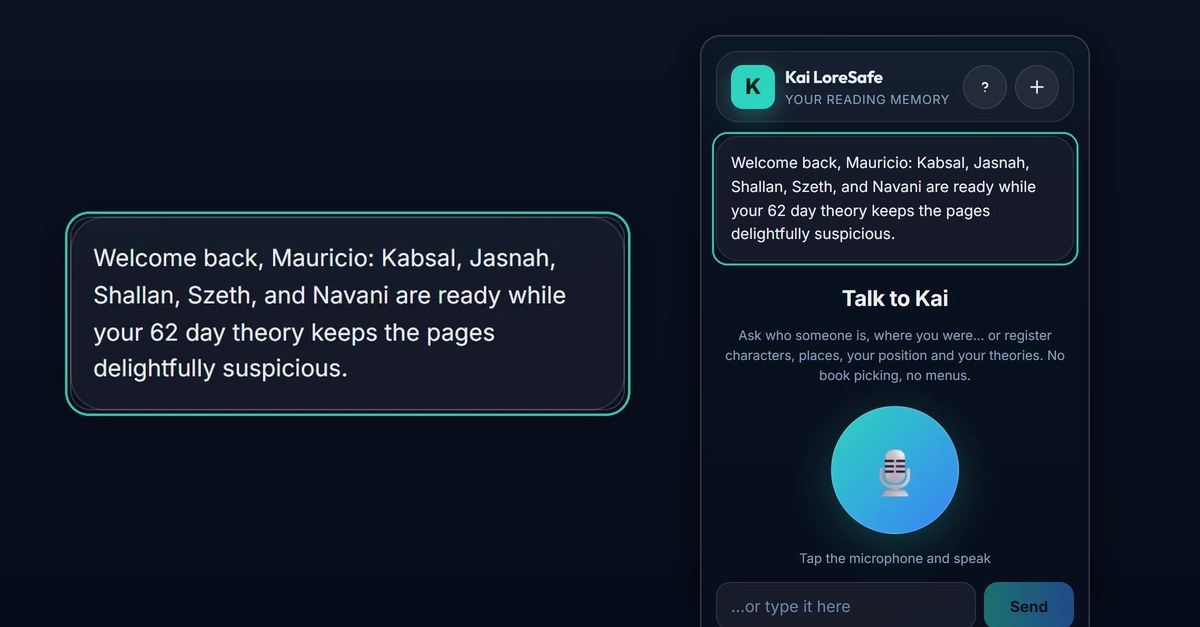
Kai LoreSafe, the tool I built, has a feature designed for exactly that moment, so read this with the bias of the person who made it. It's called, without much poetry, “where was I?”. You tell it where you stopped (the page, the percentage, or a “I stopped when they left the village”) and it gives you back where you were standing, who was who and what had been left hanging, without retelling the book and without a word about what's coming. It works better if you'd been telling it where you were before the pause, of course, because for every position it keeps the last thing that happened, and that's exactly the first thing memory lets go of.
There's one question I can't settle. Maybe some books read differently after a pause, and what was lost along the way doesn't come back with any method, because the person who picks the book up isn't the same one who put it down. Maybe. And perhaps that isn't always a loss.
Which book have you gone the longest without finishing, and on which page did the bookmark end up? And those of you who've gone back to one after months: did you start over or risk carrying on?
See you next time. Mauro Z.